Bully of Asia by Steven W. Mosher
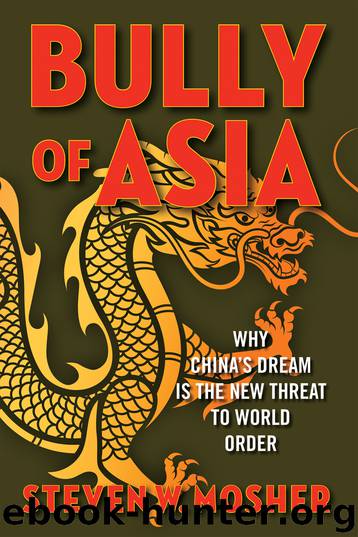
Author:Steven W. Mosher
Language: eng
Format: epub
ISBN: 9781621577058
Publisher: Regnery Publishing
Published: 2017-11-03T04:00:00+00:00
“BELLICOSE NATIONALISM”
Writing in vivid prose, Liu described with pinpoint accuracy the “bellicose nationalism” that China now exhibits at every turn and the national psyche that undergirds and sustains it. He saw Chinese nationalism as based on an unstable witch’s brew of deep-seated arrogance and conceit mixed with on-again, off-again spasms of inferiority, which are themselves back-handed psychological expressions of the same underlying narcissism.7 As Liu explained,
When a people like ours, who struggle with feelings of inferiority, have to face the facts of inadequate national strength, or of less than full respect from others, one way we try to feel better is to grab onto any piece of historical material that can make us proud. It is even all right to exaggerate a success wildly, so long as it contributes to an image of “number one” for the group. If it is hard to deny that we are inferior to others materially, we can claim, as Mao did, that we are superior spiritually. If we are not as good as others now, we can build the myth that we are bound to be the most powerful nation someday, because we certainly were in the past.8
Liu saw the “China-as-Center Mentality” as a product of China’s extreme self-absorption, based less on objective reality than on blind self-confidence, empty boasts, and pent-up hatred.9 These insights—which, again, won him a long prison term—help to explain China’s craving for international respect no less than its often undiplomatic—even warlike—rhetoric when it feels itself slighted.
China’s extraordinary sensitivity to slights is an outgrowth of the view that the world is divided between civilization (China) and barbarism (everything else). It is bad enough to be insulted by one’s equals, but to be insulted by one’s perceived inferiors is simply intolerable. And in the view of the committed Great Han chauvinist every other nation, culture, race, and ethnicity is—or soon will be—inferior to China. China’s excesses of both pride and humiliation, says China scholar William Callahan, are a direct outgrowth of this classical civilization-barbarism distinction.10 Both national pride and national humiliation work to integrate the party-state’s propaganda policy with grassroots popular feelings to produce, in Callahan’s words, a “national aesthetic that unites elite and mass views of identity and security.”11
Arguing along the same lines as Liu, Callahan describes a Chinese national psyche that has, at its root, both a “superiority complex” and an “inferiority complex.”12 The superiority complex comes from their millennia of dominating their near neighbors, while the inferiority complex is a result of the devastating effect that the clash with Western civilization has had on their collective psyche. Mao Haijian, a professor of Chinese history at East China Normal University, agrees, explaining further that his compatriots’ tendency to boast about their culture is actually an attempt to disguise their deep-seated feelings of inferiority.13
If you visit the Ming Tombs north of Beijing, where thirteen emperors of the Ming dynasty (1368–1644) are buried, you will see an illustration of the kind of mythologizing that Liu is referring to. Along the four-mile
Download
This site does not store any files on its server. We only index and link to content provided by other sites. Please contact the content providers to delete copyright contents if any and email us, we'll remove relevant links or contents immediately.
| Africa | Americas |
| Arctic & Antarctica | Asia |
| Australia & Oceania | Europe |
| Middle East | Russia |
| United States | World |
| Ancient Civilizations | Military |
| Historical Study & Educational Resources |
The Sympathizer by Viet Thanh Nguyen(4443)
The Rape of Nanking by Iris Chang(4255)
World without end by Ken Follett(3510)
Ants Among Elephants by Sujatha Gidla(3494)
Blood and Sand by Alex Von Tunzelmann(3240)
Japanese Design by Patricia J. Graham(3213)
The Queen of Nothing by Holly Black(2656)
City of Djinns: a year in Delhi by William Dalrymple(2580)
India's Ancient Past by R.S. Sharma(2492)
Foreign Devils on the Silk Road: The Search for the Lost Treasures of Central Asia by Peter Hopkirk(2482)
Tokyo by Rob Goss(2463)
Inglorious Empire by Shashi Tharoor(2462)
In Order to Live: A North Korean Girl's Journey to Freedom by Yeonmi Park(2408)
Tokyo Geek's Guide: Manga, Anime, Gaming, Cosplay, Toys, Idols & More - The Ultimate Guide to Japan's Otaku Culture by Simone Gianni(2400)
India's biggest cover-up by Dhar Anuj(2381)
The Great Game: On Secret Service in High Asia by Peter Hopkirk(2371)
Goodbye Madame Butterfly(2278)
Batik by Rudolf Smend(2210)
Living Silence in Burma by Christina Fink(2093)
